
Sea Days
Cat’s Paws and Performing Dolphins

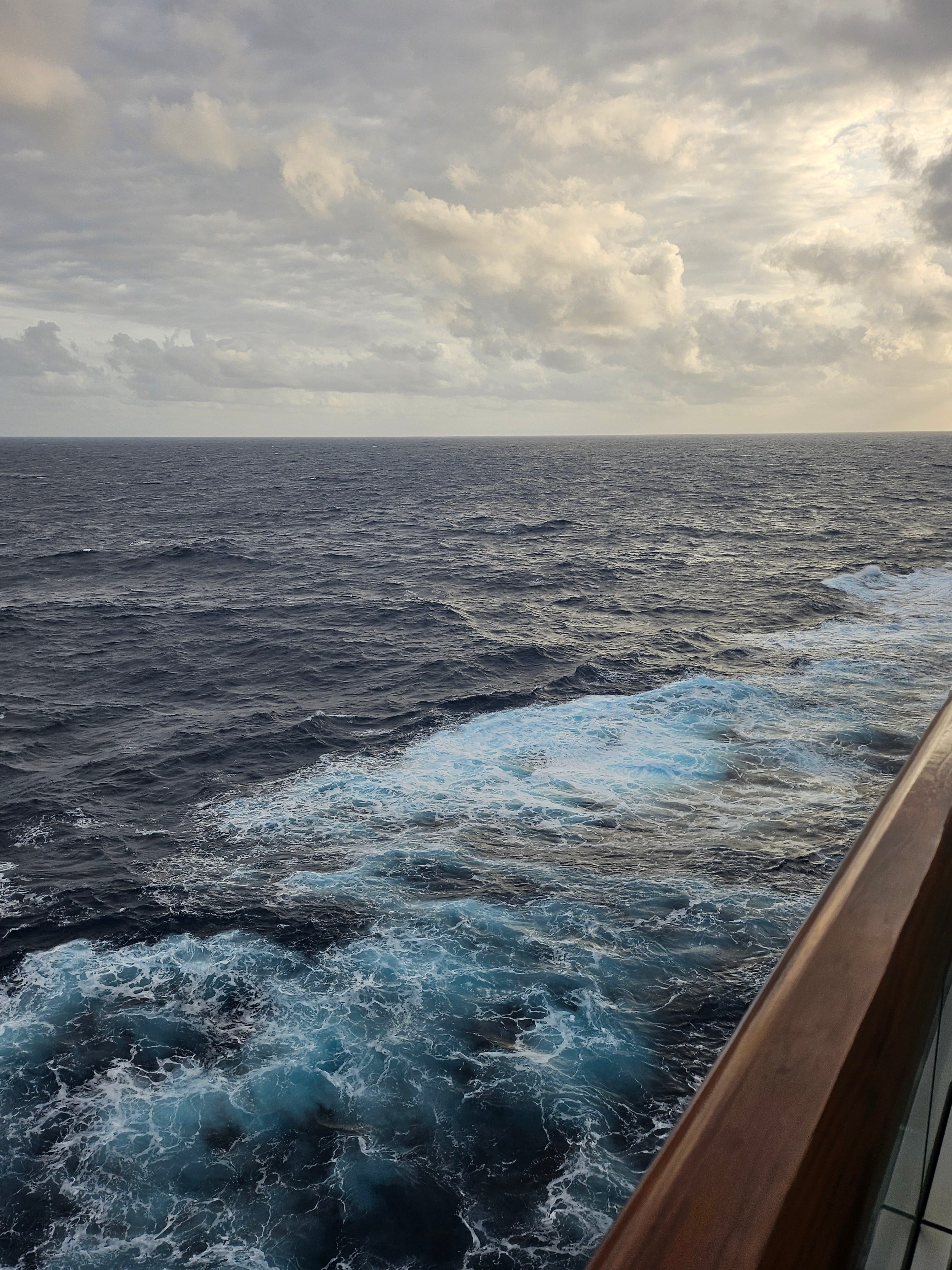
The farther south we travel down the coast of Mexico, the more the sea reveals itself: schools of dolphins roiling the surface as they arc up for air, visible for a moment, and then gone. Occasionally they perform jumps for us. Sea turtles float by at regular intervals. Seabirds skim the surface of the water (frigate birds, I’m told) and catch drafts we cannot see. After a while they dive in and pop up again, lunch in their mouth. When the bridge announces a school of dolphins over the loudspeakers, there is general excitement among the passengers. This morning we had an early stretch class topside; the announcement came and the teacher had to call a break as everyone dashed to the railing to watch a school of dolphins. When we are in our room, the announcements of sightings from the bridge are so garbled we know when we hear them that generally there’s something in the water, either port or starboard. We lean over our balcony scanning like sailors on watch. If we see nothing, we tell ourselves the sighting must have been to starboard. We’ve fallen in with a couple who sailed these waters on their own boat over the course of eight years, up to Washington and down to Equador. They point out to us ruffles in the otherwise calm sea where the wind disturbs the surface of the water. These, they teach us, are called Cat’s Paws, as if an invisible cat stepped down on the sea.
I try to use port and starboard as if I were a seasoned sailor, but internally I have to remember “left” and “port” have the same number of letters. Our little cabin is on the port side so we can occasionally see land on the horizon as we travel south. More often we see a cloudbank off in the distance hiding land. Our seafaring friends tell us that we are on the correct side of the ship to observe sealife: dolphins and whales travel closer to shore when they migrate.
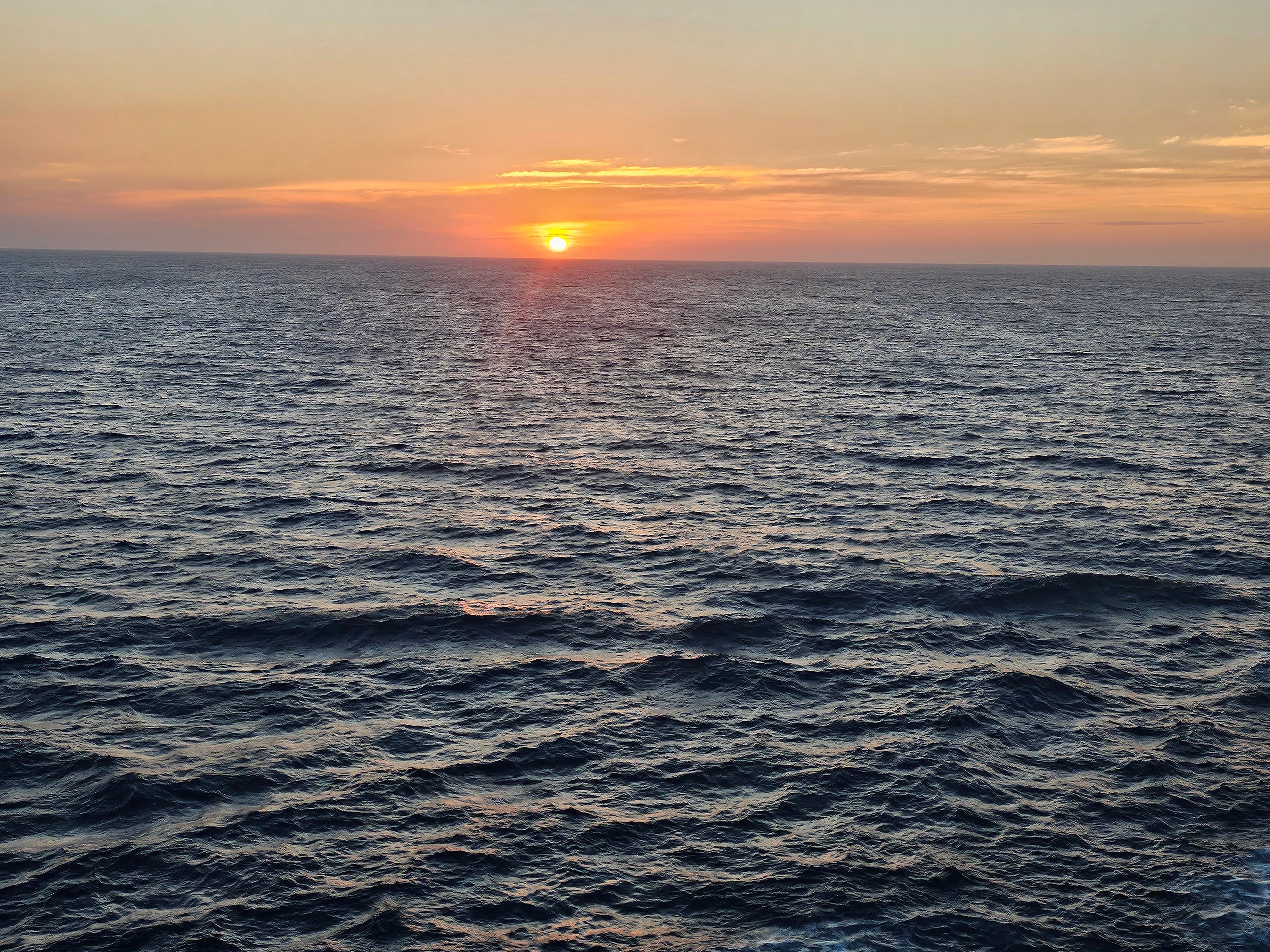
The sea closest to the ship is roiled by the prow which creates a lovely mottled turquoise with white foam veins, like marble. That immediately changes to Homer’s Wine-dark Sea, a deep navy blue, almost purple. As you gaze out farther the surface reflects the blue of the sky, but imperfectly. There is still that mysterious darkness in the water that bodes ill for the passenger who broods at the rail. The darker sea touches the horizon and the pale gray-blue of the sky. The sky, pocked with cottonball clouds at the horizon, shades as you look up to a lovely azure. At dawn the sun on the horizon paints the crests of the wave gold and orange for just a moment, making your early rising worthwhile.
Time slips by and a kind of luxurious boredom creeps in, the boredom I thought I’d left behind as a schoolchild lounging with friends on long summer afternoons. No anxieties cloud the future, no regrets haunt the past. The ship offers a list of activities that would shame the most extravagant retirement community, but it also offers quiet for those seeking to rest mind and soul. We tell ourselves we are looking for signs of wildlife as we gaze out at the gentle waves, but what we find is peace.
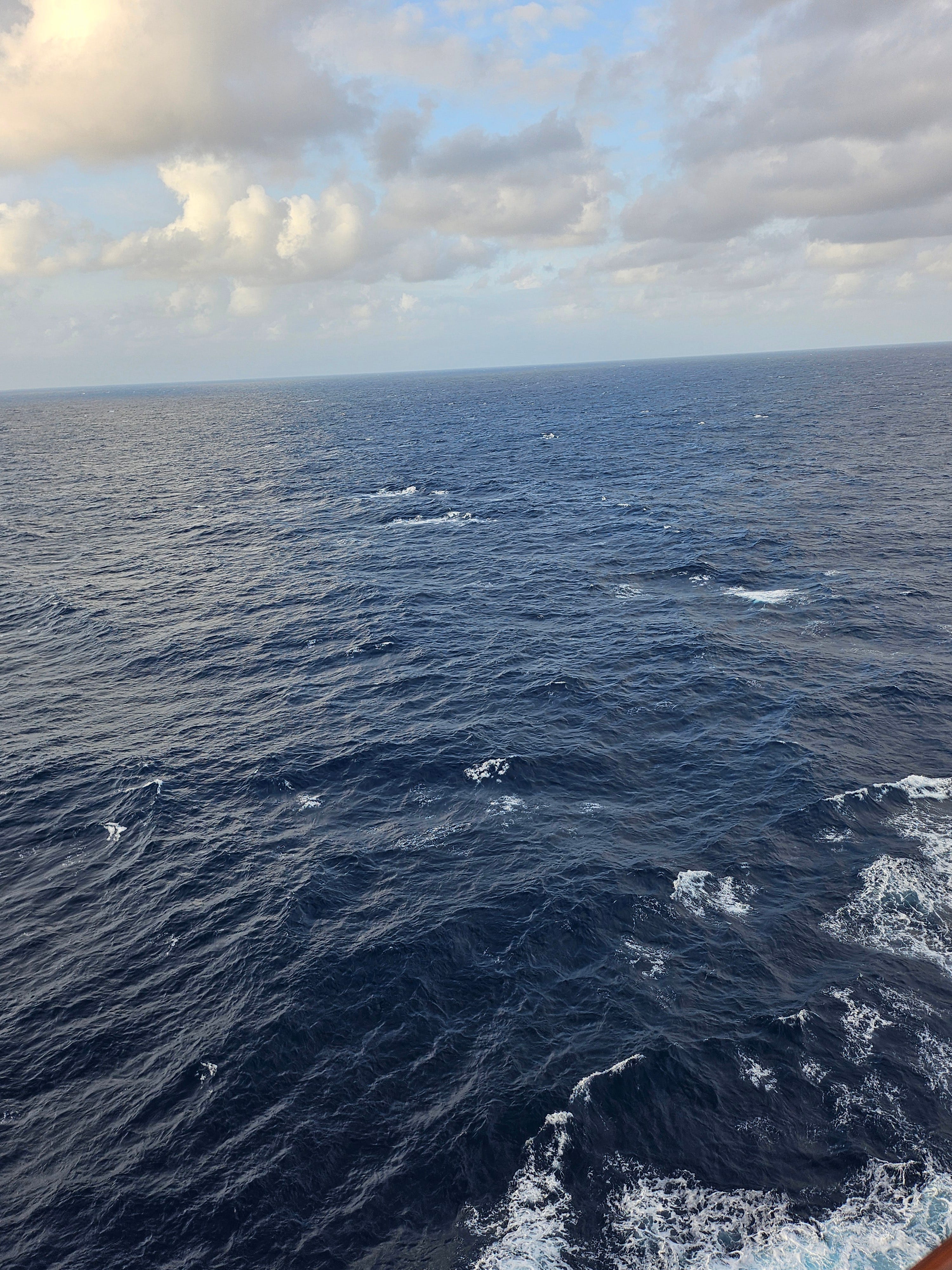
A day later we sail farther out to sea to avoid the worst of the papagallos winds off Nicaragua, but the waters were still troubled. The newest Cunard ship shudders like an old train as the waves batter the port side, closest to land. Penny is worried but I tell her that creaks and moans show the ship is a little flexible, only half-believing myself. Whitecaps stretch to the horizon; swells jar the ship when they hit, sending out small shockwaves that feel like a bump in the road. Penny gives me my twice-monthly haircut on our balcony and her hand jiggles when we feel the thumps.
That night we watch the spectacle of a silent lightning storm from so far away we only hear the booms in our minds. The inky blackness hides everything, sea and sky, and then a bright light illuminates both at once, revealing the clouds and rough water for a second. Some of the lightning is deep in the clouds, like angry monsters walking up there. Next we see a bolt of lightning across the sky, making all things to the horizon bright as day, though in black and white like an old movie. The light show allows us to understand the supernatural beliefs of ancient sailors who must have seen the work of angry gods in these skies. I imagine them falling silent to avoid any noise that would reveal their ship’s location and turn that awful wrath in their direction.
We wake the next morning to a perfectly pacific Pacific. No sign of wind, waves or drama. The dark clouds of a weather front hide the horizon but are too far away to threaten our peace.
What lovely writing about 'the restfulness of freedom from the past and worry for the future'. Hello to you both and we are looking forward to the next report.
You are such a poet, Ralph! And Penny is a wonderful muse -- what a pair you are!