North to Inverness
Meeting St. Columba and Nessie

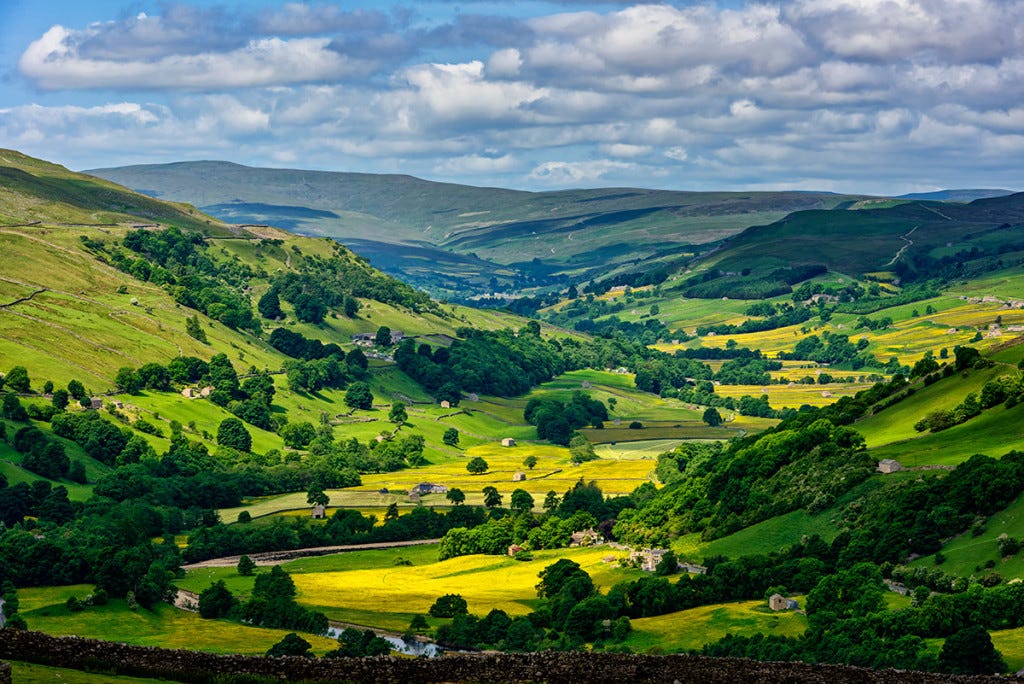
Yorkshire is the countryside that most Americans imagine when they think of England: impossibly beautiful rolling hills bisected at neat right angles by drystack walls and populated with sheep like dotted clouds floating across vibrant green pastures. From our train window we see lambs everywhere doing what they do best — they lie together in twos and threes, or gambol and play or punch the underside of their moms with their noses, looking for a drink. Every once in a while the hills rise up to crumbled rocky outcroppings that reveal the source material for those drystack walls. The occasional tall oak, fully leafed out in early May, provides perspective to the panorama. A lazy old canal parallels our tracks for a while, its tow path now hosting joggers and cyclists. It’s all picture-perfect, which is good because we are on a train north to Inverness, and we have a long way to go.
We share with the friendly locals in the seats facing us how much we love British trains. They give the response we’ve come to expect, a grimace and shrug. They have no idea what American passenger rail service is like. This Yank notices the customer service first: friendly ticket agents, generally clean stations, helpful conductors, mostly punctual trains. And there’s the physical infrastructure — nineteenth century bridges and viaducts, wildly overbuilt. (How could British engineers have anticipated modern semi trucks traveling over bridges built in the days when horsedrawn haywagons were the heaviest vehicles on the road?)
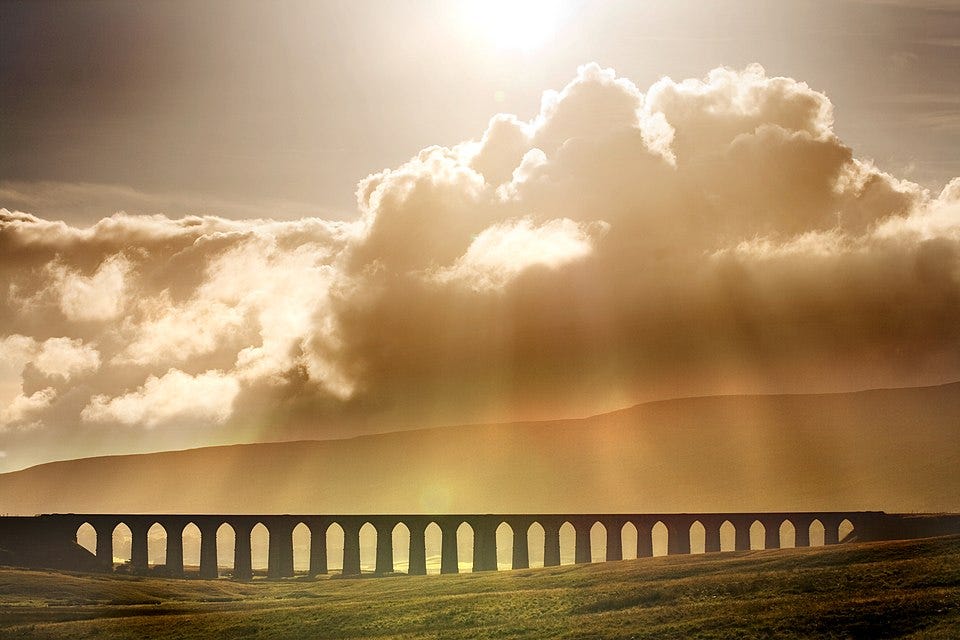
We view and then pass over the Ribblehead Viaduct, built in 1869, a monument to the triumph of nineteenth century British engineering in the middle of nowhere, 24 arches spanning an undistinguished valley. The pointed arches remind us of a ruined cathedral. The rural stations are beautifully built in iron and brick, with potted flowers in boxes everywhere. We are viewing the consequence of the intersection of nineteenth century engineering genius, national will, cheap materials and cheap labor. I recall America’s last great national infrastructure building project, the freeway system of the 1950s. But freeways are built of poured and cast concrete, not the lovely red brick and stone used by the engineers who built the old railroad. Even 150 years of industrial pollution feels like patina on the surfaces of the bridges and station houses.
Today the trains are running late because there is repair work on the tracks all up and down the line. We only made our Carlisle connection because the train we needed to catch was itself late. But then our luck ran out: we just missed our connection at Edinburgh. As we stepped off the train a station employee was waiting to shoo us onto an alternate train that got us to our destination only an hour later. During this last leg, the landscape out the window was rougher, rockier. Farms are still green, but no lambs frolicked among the sheep (is it not yet lambing season up north?). The farms here grow bright yellow fields of rapeseed in patchwork patterns on the hillside. As we approach Inverness we see the leftovers of last winter’s snow streaking the surrounding mountains.
How far away is Inverness? Really far. We rode trains north for about nine hours to get here from Leeds, in the center of England (this after a 4-hour journey from Southampton to Leeds). Inverness is the same latitude as Juneau, Alaska. Our first morning here we are awakened by daylight streaming in our bedroom window at 4:45 AM, in early May. That’s how far north we are.
The days are coolish but not bitter cold, and we were happily surprised to have a sunny day for our guided walking tour around the city. We were Alan’s only customers that weekday morning, and he was delighted that we showed a lively interest. Indeed, he agreed to our offer of a cup of tea at the end of the tour, continuing our conversation about the convoluted history of Scotland.
The Romans never made it this far, so there was no Roman “civilizing” influence on the tribes and clans of the north. Remember Hadrian’s Wall? This was the demarcation, more or less, of Rome’s reach to the north. The Picts emerged during the very early middle ages from among the clans spread thick around the north, and came the closest to unifying the Highlands under one chief. There is a lovely legend about St. Columba visiting the Pictish King Bridei (or Brude) in Inverness in the 500s. Columba was sailing up the Loch Ness from Iona to meet the king when he saw a great monster coming out of the water. He blessed the beast and commanded it to never eat a human again (this was Nessie’s first appearance in print). But Columba was just getting started; he picked up a stone from the loch, blessed it, and sent it on ahead to the king as a gift. When dropped in water, the stone not only cleared the water, but created a healthful potion. The ungrateful king barred Columba from his Inverness castle by shutting the gates, but the saint merely made the sign of the cross and the gates opened for him. According to the Vitae Columbae (Life of Columba), the king and Columba parleyed at the castle on top of a local hill, after which the king was so impressed with Columba’s eloquence he demanded the conversion of all Picts to Christianity, then and there. In fact, the tribes and clans across the north were much more diverse and willful, so the conversion of the Highlands was more gradual.
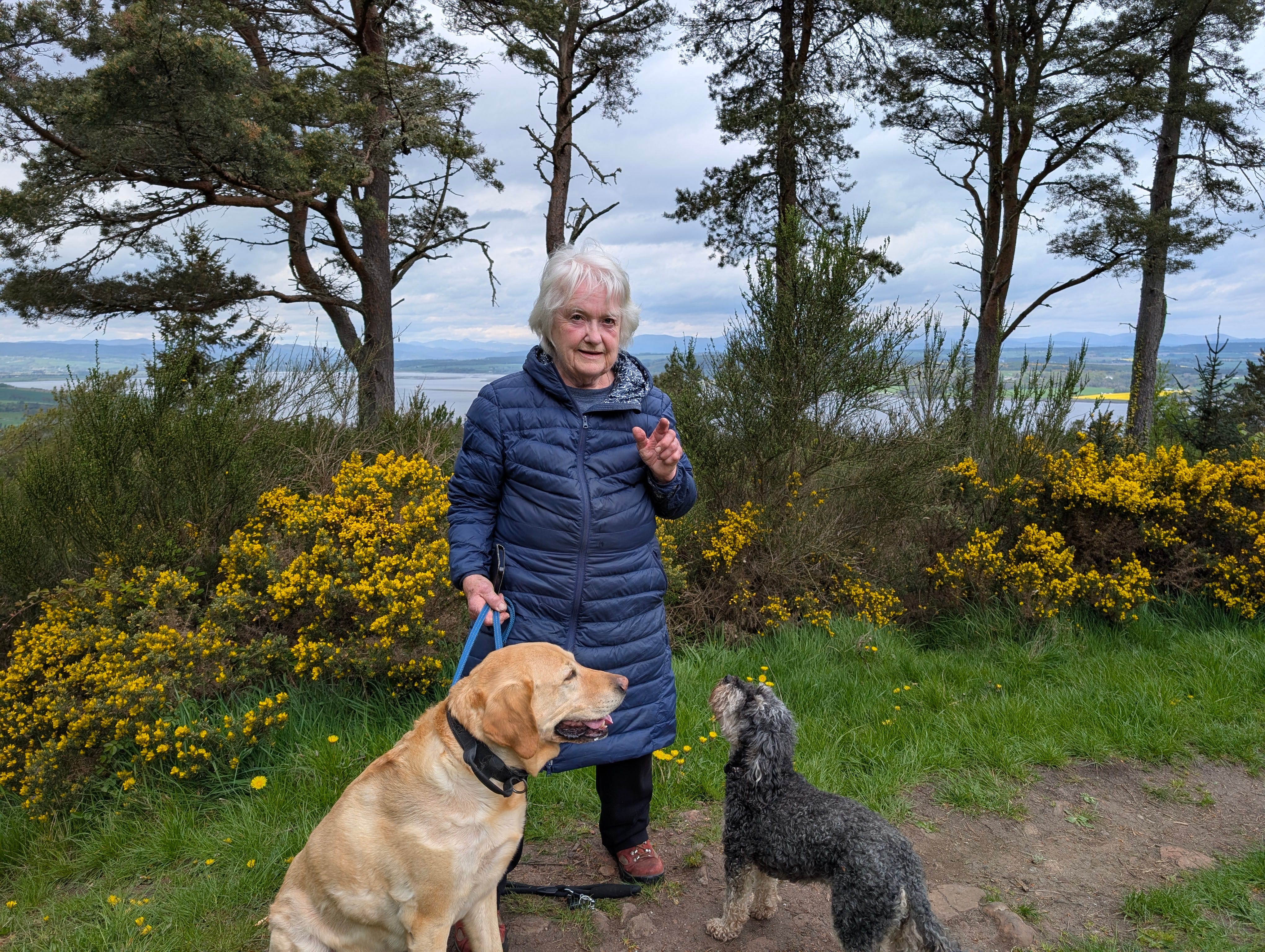
Our first Inverness hike was four miles up to the top of Craig Phadrig, where legend has it the parley occurred between Columba and the king. Except for the stunning setting and views, there’s not much here, as Brede’s “castle” was actually a wood and dirt motte and bailey fort, built, archeologists believe, in the fifth century. Only the steep hill of the motte and the stone foundations of the motte’s earthen walls can be seen. The living areas inside the fort were all wooden roundhouses, now gone. On our hike we met Judith and her two old dogs, who led us to the top of the hill. We had a lovely conversation about her dogs and the joys of living in Inverness.
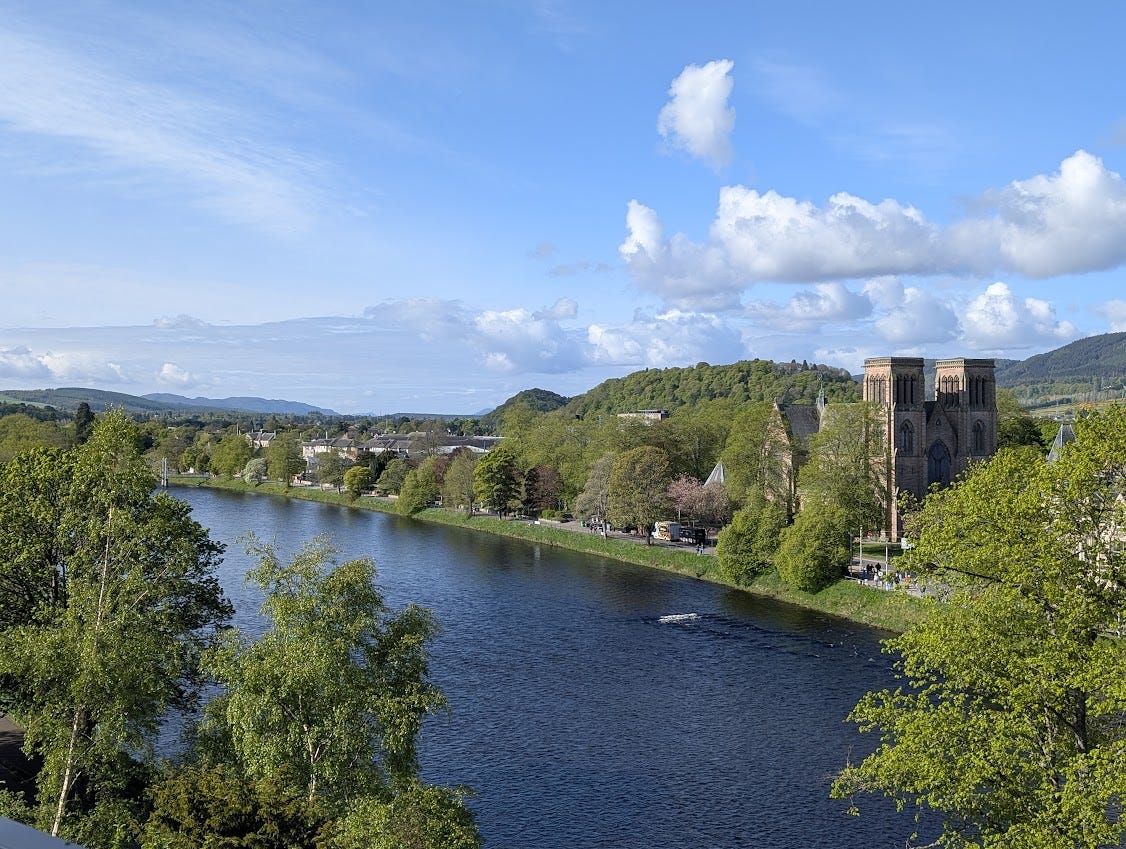
Today Inverness is a peaceful and prosperous port city, retaining a real grittiness despite its veneer as a tourist destination for all things kilts and Nessie. We walk down its main streets and check out the shops selling Harris Tweed and Shetland wool articles. Trinket shops sell images of Nessie or Highland cows glued, stenciled, painted, or stitched onto any article you might want to buy. Still, we are warming to this cold town on the River Ness.