
Dundee
Jam, Jute and Journalism

On our way south to Bath we decided to stop for a couple of days in Dundee, the fourth-largest city in Scotland, where the River Tay meets the North Sea. Dundonians like to call their home the “City of the Three J’s”: Jam, Jute, and Journalism.
Jam
Keiller’s Dundee Orange Marmalade originated right here. The story goes that the marmalade was invented when a load of un-saleable Seville oranges reached Dundee and the mother of a local grocer turned them into the world’s first orange marmalade. In fact, in 1797 a local confectioner began selling his mother’s marmalade from an old family recipe, unique owing to its thick orange slices, as a cure for indigestion. The idea caught on as did the characteristic pots they put it in and Keiller’s Dundee marmalade circled the globe as the British Empire’s preferred spread.
Journalism
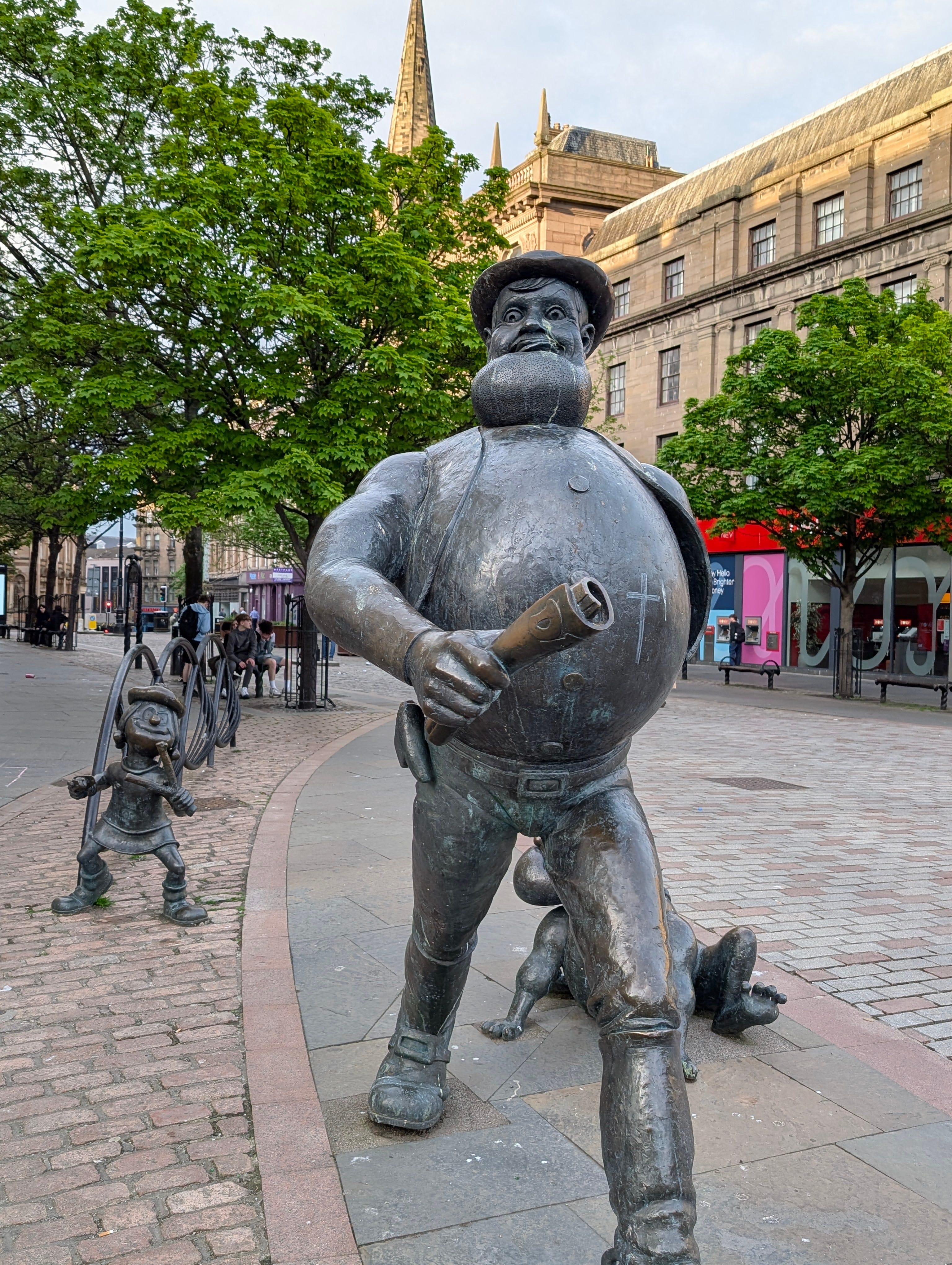
The journalism “J” is more obscure to us Americans and involves the national children’s weekly with lovable cartoon characters that took off in popularity in the late nineteenth or early twentieth century. Friends tell us they grew up reading the adventures of Desperate Dan each week.
Jute
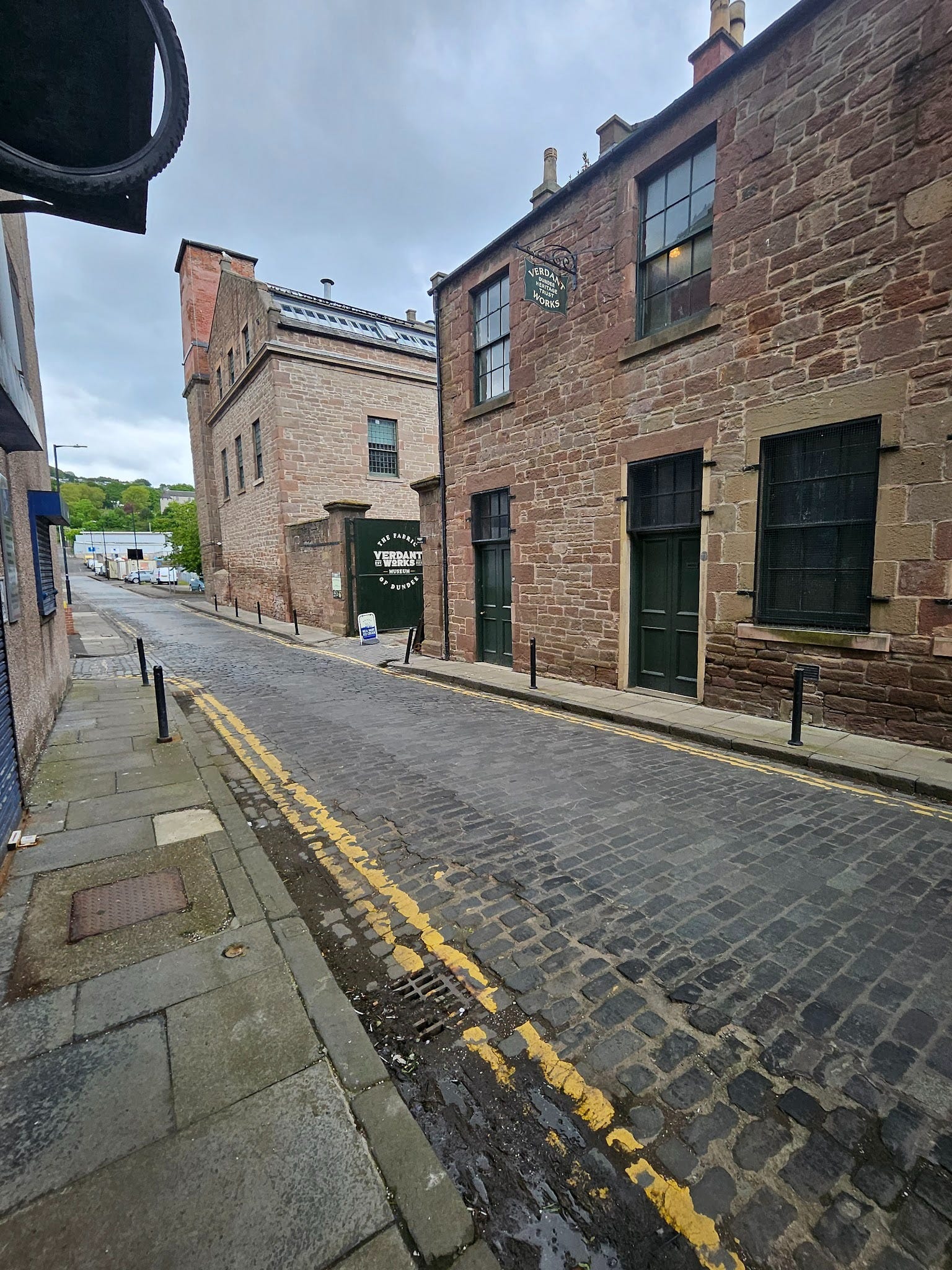
I wanted to learn more about the industry that made Dundee rich during the industrial revolution: the manufacture of jute products. Dundee was making textiles from wool and flax when someone got the idea of applying industrial design to the manufacture of cheap jute products to make burlap bags and canvas for sails. The idea gained traction through the nineteenth century and soon Dundee was marketing itself as “the servant of industry” for all the jute bags and other jute-related products it provided to other manufacturers. Penny and I visited the Verdant Jute Works Museum to observe this complicated multi-step process. But what interested us most was the social history of jute production in Dundee.
First of all, the jute industry dominated Dundee manufacturing. By the late nineteenth century more than half the city’s workers were involved in jute manufacture. Factories were so thick in one area of the city that the neighborhood still goes by the name “Blackness,” for the smoke its industrial chimneys produced. The barons of jute were known for two things: hiring women (especially married women), and for paying the lowest industrial wages in Scotland. Factory owners bet that women would accept the cultural norm dictating they be paid less than men, and that women would be less prone to strike over wages and conditions than male workers. Dundee got the nickname “She-town” during this period because visitors watched while women with families went off to work, leaving unemployed husbands to mind the children. Seventy-five percent of the workers in jute manufacture were women, virtually all on the factory floor. Promotion was out of the question as the natural order dictated men supervise and fix the machinery. Manufacturers also hired young children, creating truly Dickensian conditions in Dundee through the nineteenth century.
Jute grows in India, where the hot wet conditions are ideal for the plant. By the late nineteenth century profit-obsessed manufacturers realized it was much cheaper to process jute there and ship the finished product around the world than to carry the raw material all the way from India to Dundee for manufacture. And so Dundee factory jobs began moving off-shore starting in the first part of the twentieth century, and scourges like “factory cough” from the jute fibers in the air along with the eternal sootiness of the Blackness, slowly turned into memories for Dundonians as they became the new reality for workers in India.
Design
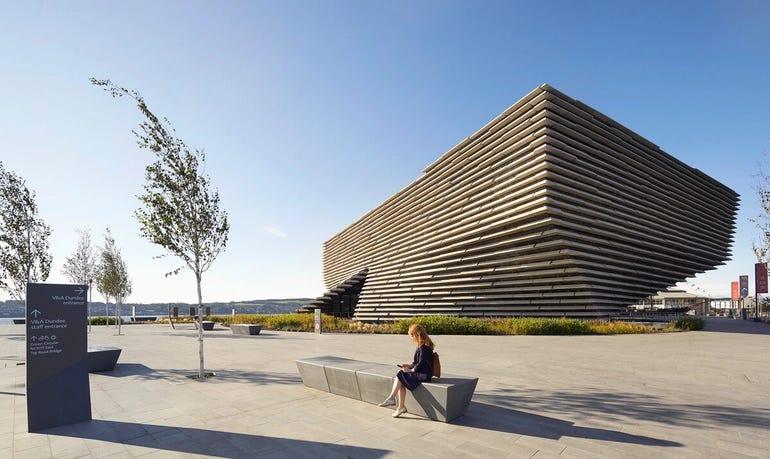
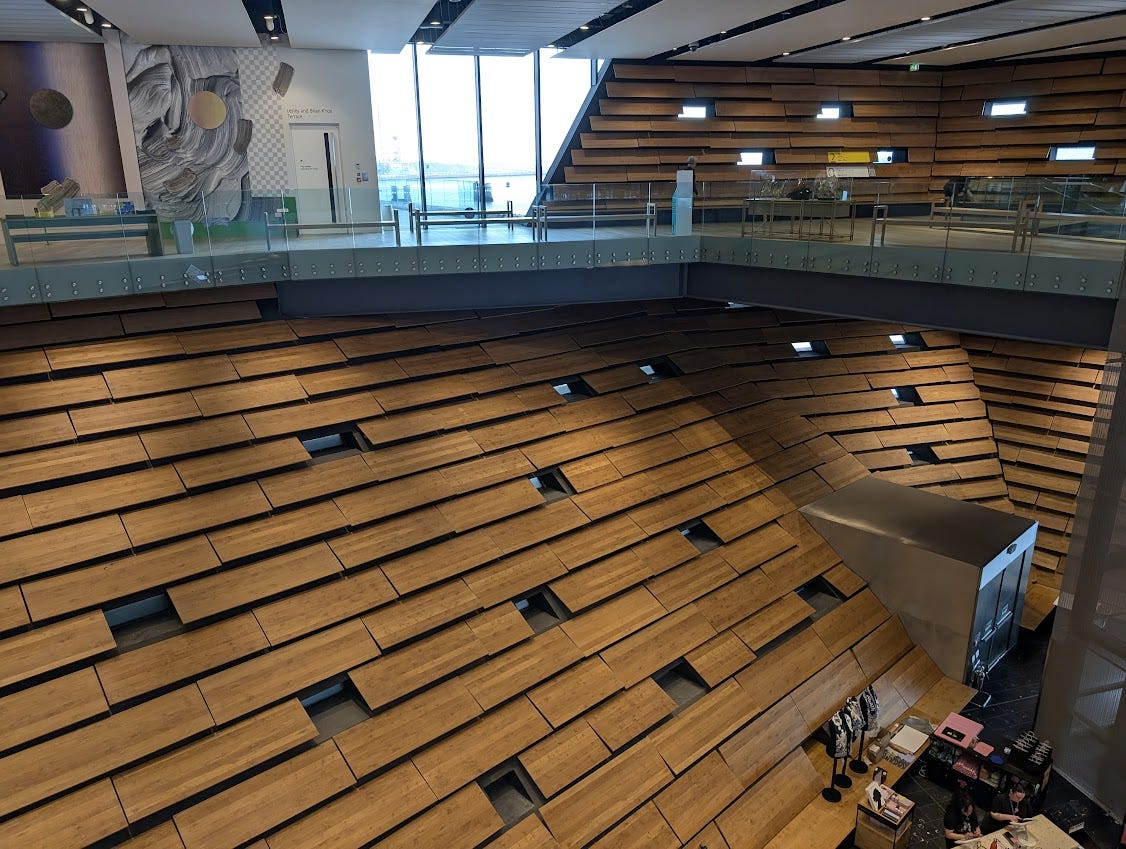
Dundee’s urban rejuvenation is tied to the beautiful new waterfront Victoria and Albert Museum of Design, completed in 2018. The radical design of the design museum contrasts sharply with the Victorian architecture preferred by the nineteenth century jute barons who endowed the city with public buildings and amenities as a way to distract themselves and others from the squalid conditions of their workers.
One of the exhibits in the museum highlighted Maggie’s Place, an organization of thirty or more cancer respite centers in Great Britain and the world (but not the US) designed by famous architects to help people “not to lose the joy of living in the fear of dying.” The really gorgeous architecture integrates nature and warm welcome in creative ways. A typical example of the kind of architecture and design they use is Maggie’s Place Dundee, which we didn’t get a chance to visit.
On to Bath!

Hi Ralph! I wonder if you’ll remember us - Cindy Boyle and Bob Nessen. We met you and Penny on the Queen Mary back in August when you were returning “home” after your long adventure and had a couple of dinners together. We really enjoyed meeting you both, and I am so glad I subscribed to your substack. I’m following along and enjoying your travels and commentary through Scotland. Keep it coming!
Since we last saw you, we moved into our new home in Bedford, MA, spent January, February, and early March at sea: 8 days crossing the Atlantic to Southampton (where I contracted pneumonia), then 50 days aboard the Silversea Muse in the cold, rainy, stormy Mediterranean! But we had a great time and managed to have a few gorgeous late February/early March weeks along the French and Spanish coasts.
In July we will cruise up and down the New England and Canadian coasts for two weeks. Then in mid-August we head to Amsterdam for a 3-week cruise, starting with a counterclockwise circuit of the British Isles. We end by sailing the west coasts of France, Spain, and Portugal.
IF IF IF your travels take you in that direction between August 16 and September 7, we’d be thrilled to see you! I’d love to hear from you and/or Penny. I wish you good times, interesting people and places, and good health as your adventures continue.
Cindy
All very interesting! I love that marmelade and in fact, my dad always had a jar of that in our home growing up. I still have one of the crock like containers around here somewhere. Desperate Dan? Very odd indeed. Tales of jute, sad and typical and sad. The museum structure is gorgeous and unusual. And of course you're familiar with Dundee, OR famous for it's vineyards - I wonder if it it was originally inhabited by the Scottish ...